
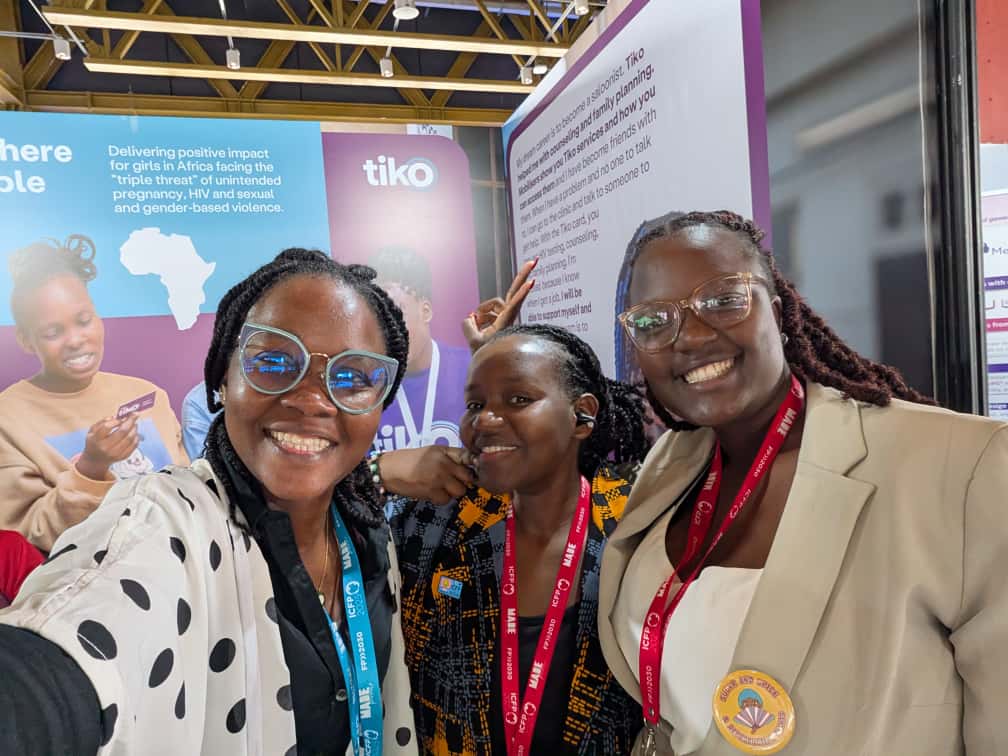
Across Africa, youth advocates are transforming the conversation on adolescent health, confronting head-on the triple threat of teenage pregnancy, HIV, and gender-based violence. Their work is reshaping communities, challenging stigma, and proving that young people are not just beneficiaries of change but powerful agents driving change.
As the International Conference on Family Planning (ICFP) 2025 unfolds, three inspiring young leaders, Esenam from Ghana, Lucy from Kenya, and Amanda from Uganda share their journeys, their passion for advocacy, and their commitment to building a future where every girl has the freedom, power, and opportunity to thrive.
From Ghana: using storytelling to drive change
“I grew up in a slum in Ghana and saw firsthand the reproductive health challenges girls face,” says Esenam Amuzu, a community reporter with the Family Planning News Network. “When I got the chance to create change, I knew I didn’t want any girl to lack access to sexual and reproductive health information. That knowledge is power.”
Through her work, Esenam has found the perfect intersection between journalism and advocacy, using the power of media to amplify community voices and challenge social norms. At ICFP 2025, she will report from key sessions, present her poster, and MC The Frontline Report a side session on “The Investment Case for girls’ health and wellbeing care in sub saharan Africa by Tiko, a youth-led platform amplifying the voices of young people in global health spaces.
“Adolescent girls remain at the heart of these issues,” she says. “Keeping them at the centre of conversations ensures targeted interventions that address the realities they face. Journalists have a duty to tell these human stories. Stories of strength, hope, and resilience.”
From Kenya: centering community voices in global conversations
For Lucy Achieng Onyango, a youth advocate from Bungoma County, Kenya, change begins within communities. As Programmes and M&E Lead at Girlpower Community-Based Organization and the End Femicide Coordinator, Lucy advocates for stronger investment in grassroots-led interventions that prioritise local realities.
“At ICFP, I’m bringing the message that we must centre community advocacy and invest in empowering local organizations,” she says. “We need youth-friendly centres and safe spaces where young people can access information and services without stigma or fear.”
Lucy describes the triple threat as a daily reality in her community where girls drop out of school due to pregnancy, adolescents living with HIV face stigma, and survivors of violence are left without support. “These challenges are compounded by poverty, social norms, and lack of youth-friendly services,” she explains. “But with the right support, these same young people can turn their pain into power.”
From Uganda: defying barriers and inspiring hope
For Amanda Banura, co-founder of the Uganda Youth Alliance for Family Planning, her advocacy journey began after attending ICFP in 2013. “I realized how little information young people in Uganda had about family planning,” she recalls. “Teenage pregnancy and gender-based violence were rising, and I knew something had to change.”
Her organization now focuses on reducing teenage pregnancy, HIV, and GBV, issues that remain deeply rooted in cultural, religious, and systemic barriers. “Sex education is banned in schools, service providers often stigmatise young people, and poverty pushes girls into risky situations,” she says.
Despite these challenges, Amanda’s optimism remains certain. “We’ve seen progress. Adolescent health guidelines, more youth-friendly clinics, and growing awareness,” she notes. “My message to young people: you are the change you want to see in the world, it starts with you. Don’t drown in your situation. Stand up. You are stronger than you think.”
From Ghana to Kenya to Uganda, these young advocates are united by a shared vision; a world where every girl can grow up safe, informed, and free to make her own choices.
Their message to leaders, policymakers, and peers at ICFP 2025 is both clear and urgent:
“There is no better time to build a collective front. Governments must commit to funding sexual and reproductive health and rights and listen to the voices of young people. We cannot fail the adolescent girls who are counting on us.”
At Tiko, we are proud to stand alongside these voices, amplifying their stories and working hand in hand with youth-led organisations to end the triple threat. Together, we are driving progress toward a future where every adolescent girl has the opportunity to thrive.
We are grateful to Esenam and Amanda for co-moderating Tiko’s session on The Investment Case for Girl’s Health and Well-being Care in sub-Saharan Africa at ICFP 2025. We were also delighted to welcome Lucy as part of the Tiko delegation at the conference where she represented girls’ voices on Tiko’s panel events.