
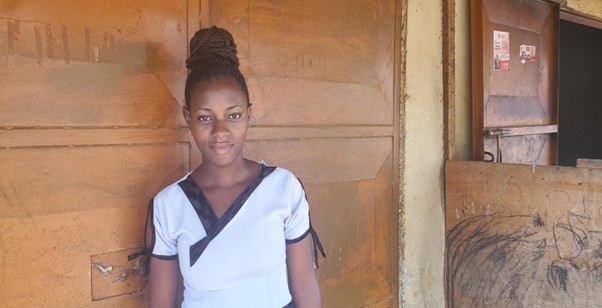
At just 24 years old, Aisha has faced more pain than many people do in a lifetime. But today, her smile shines a little brighter, and her voice carries strength and hope.
“I used to be full of dreams,” Aisha says quietly. “I wanted to become a psychologist and help others with their emotions. But everything changed so fast.” Aisha was a bright and ambitious student. But her dreams were cut short in senior school when her family hit a financial crisis. She was forced to leave school. “It broke me,” she says. “I stayed home, watching others go on with their lives while mine stood still.”
Aisha lives in Kyebando Kitablik, a slum in Kampala, where life is tough. The community struggles with poverty, high rates of violence against women and girls, teen pregnancies and poor access to health services. “When I dropped out of school, I didn’t just lose my education. I lost my confidence, my routine, my purpose,” Aisha recalls. “I started feeling so alone, and the sadness wouldn’t go away. I couldn’t sleep. I cried a lot. I just stayed in my room.” Aisha’s turning point came unexpectedly. Jonah Mwoya, a mental health facilitator from Tiko, met her during a door-to-door visit in her neighbourhood. “She didn’t want to talk at first,” Jonah remembers. “She was withdrawn and scared. But after a mental health screening, I saw that she had symptoms of moderate to severe depression.” Jonah invited Aisha to join group therapy sessions run by Tiko. “I was scared,” Aisha admits. “I didn’t know anyone, and I didn’t think talking would help.”
But something inside her said she had to try. And that small decision changed everything. The group therapy gave Aisha a safe space to share her feelings without fear of judgment.
“In the first session, I just listened,” she says. “But when I heard others talk about what they were going through, I realised I wasn’t alone.” Jonah and the other facilitators helped Aisha and her group members set personal goals. For Aisha, her goal was to rebuild her self-esteem and learn ways to cope with her emotions. “I started doing small things like taking walks, journalling, and reaching out to a friend when I felt down,” she says. “I also learned how to take care of myself, even if things around me weren’t perfect.”
Through six therapy sessions, Aisha began to feel stronger. She began sleeping better, smiling more, and believing in herself again. “After the sessions, I felt like I had power again,” Aisha says with a proud smile. “Now, I know how to handle my emotions. I can manage the sadness without letting it control me.”
Although she didn’t get to finish school or study psychology, Aisha now uses what she learned to support others in her community. “I talk to girls who feel like giving up. I tell them, ‘I was once in that dark place too, but I found my way out.’” Aisha’s story shows the deep need for mental health support, especially for young people in low-income communities. “There’s still a lot of ignorance about mental health,” she says. “Many people suffer in silence because they think they are alone or they are weak.”
Jonah agrees. “That’s why we need more awareness. If more young people knew that help is available and that healing is possible, we would see more stories like Aisha’s.” Today, Aisha stands tall. She may not have taken the path she once dreamed of, but she has found a new purpose. “I still feel sad sometimes,” she admits. “But now I know that sadness doesn’t have to stop my life. I’m not afraid anymore.” Her advice to others? “Don’t suffer in silence. Speak to someone. Join a group. There is hope even when it doesn’t feel like it.”
Aisha’s story reminds us that mental health struggles can affect anyone. But with the right support and hope, it is possible to heal.
Tiko’s work in Uganda includes sexual and reproductive health services, HIV services and mental health support for vulnerable adolescent girls and young women. Tiko unites an ecosystem of existing, established partners to provide an environment enabling girls to choose when, where and how they meet their health and wellbeing needs.
*This story was written by Tiko with consent from Aisha